

A landlord’s appliance safety plan should identify supplied equipment, check its condition and arrange competent testing where appropriate. PAT testing helps manage that responsibility, but private and social renting have different requirements. Begin with an inventory and a process for responding to defects rather than assuming an annual sticker answers every question.
PAT testing for landlord-supplied appliances
Walk through the property against its inventory. Include mains-powered appliances supplied for tenants, such as kettles, microwaves, vacuum cleaners and extension leads. Record the make, model, location and a recognisable asset number. A fridge is not exempt simply because it normally stays in one place.
Separate landlord equipment from tenants’ belongings. Agree access before moving heavy appliances and look for crushed cables, missing parts and unsuitable repairs. At each change of tenancy, compare the equipment with the register rather than assuming every item is the one originally supplied.
Understand the rules for your tenancy
Private landlords in England must ensure supplied appliances are safe. There is no blanket rule requiring annual PAT testing of every private rental appliance. Risk, manufacturer instructions and applicable property licence or contractual conditions should inform maintenance.
Social landlords have additional duties under the regulations extended in 2025. Government guidance requires qualified-person equipment checks at least every five years, or sooner where the record requires. For existing social tenancies covered by transitional arrangements, initial checks must be completed before 1 November 2026. This is separate from inspection of the fixed electrical installation.
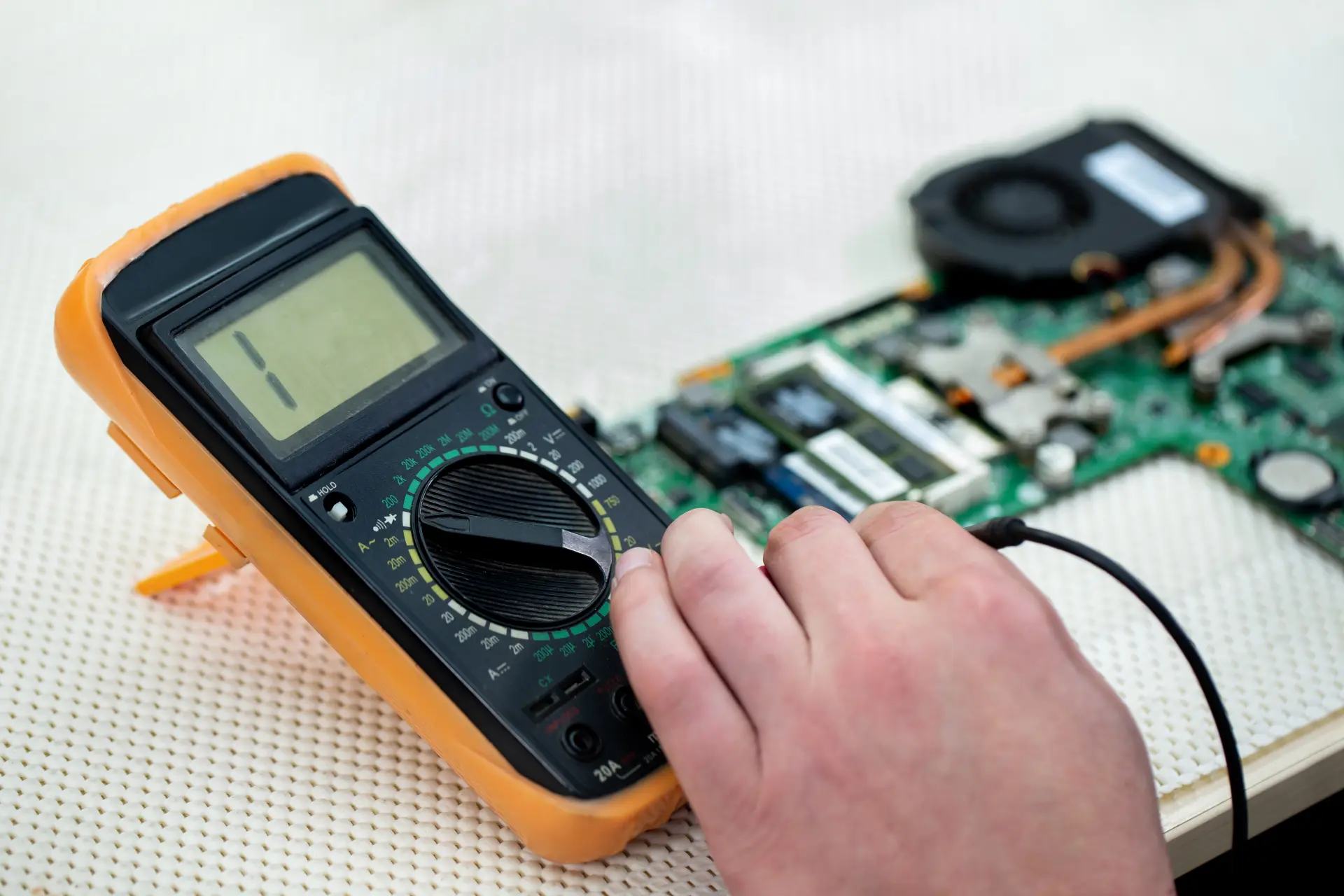
Illustrative image from the existing site library; multimeter beside an exposed computer circuit board.
Know what PAT can establish
Inspection considers the casing, plug, cable and suitability for the surroundings. Appropriate instrument tests assess electrical safety features that cannot be judged by looking. The tests depend on appliance construction; a single automatic sequence is not suitable for every item.
A satisfactory result describes the condition found during the visit. It cannot guarantee safety after a cable is trapped or liquid enters the appliance. PAT also does not replace the Electrical Installation Condition Report, or EICR, covering fixed wiring, sockets and the consumer unit.
Keep records that lead to action
Ask for an equipment register showing each item, its outcome and limitations. Inaccessible appliances should have an explicit status. Keep repair details, replacement receipts and subsequent checks with the property records. Social housing records have specific retention and disclosure requirements.
Remove unsafe appliances from use and tell the tenant clearly. Do not leave a failed kettle in a cupboard where someone can reconnect it. Update the register when a replacement is supplied, and give tenants an easy way to report problems between formal visits.
Put current safety figures in context
Electrical Safety First reports 13,537 accidental electrical dwelling fires in 2024/25. That figure covers electrical fires broadly, rather than incidents PAT would necessarily prevent. It supports paying attention to damage and fault reports throughout a tenancy.
A practical programme also checks product recalls and retains operating instructions. Schedule checks around actual risks and findings, and respond promptly to reports of overheating or damaged cables. A date on a label should never be used to justify keeping visibly unsafe equipment in service.
Sources and further reading
Guidance checked on 22 October 2026. Data periods are stated in the text; illustrative calculations are not survey findings.
Summary
Maintain an accurate appliance register, apply the correct tenancy rules and act on defects promptly. For help organising checks on landlord-supplied equipment, explore the PAT testing service below.