
Many home EV chargers in England qualify as permitted development, but the answer depends on the property, equipment and parking arrangement. The rules changed on 21 October 2026, including provisions for authorised cross-pavement charging. Check current conditions before ordering, particularly for listed buildings, conservation areas, flats and on-street parking.
EV charger planning rules in England
Permitted development removes the need for an application only where all relevant conditions are met. It does not remove other approvals or give rights over someone else’s land. England’s rules should not be assumed to apply elsewhere in the UK.
The Planning Portal says new rules took effect on 21 October 2026, with the previous rules also available until 20 October 2027. During that transition, ask the local planning authority which route covers your proposal. Retain drawings, dimensions and written advice instead of relying on a generic assurance.
The government’s 21 October 2026 announcement reports UK electric-car sales in September were 36% higher than a year earlier. Increased uptake explains the relevance of charging access, but does not change the consent needed for an individual property.
Wall-mounted outlets have location conditions
Under the new Class D summary, the outlet and casing must not exceed 0.2 cubic metres or be installed more than 1.6 metres above ground. Residential conditions also address conservation areas and the number of outlets. Measure the actual equipment and proposed mounting position.
Where a residential wall immediately adjoins a highway, projection and distance from the carriageway matter. The new summary includes a 0.2-metre projection limit and minimum 1.5-metre clear footway width measured from the outermost projection to the carriageway. A compact wallbox does not automatically satisfy every requirement; have its position checked before installation.

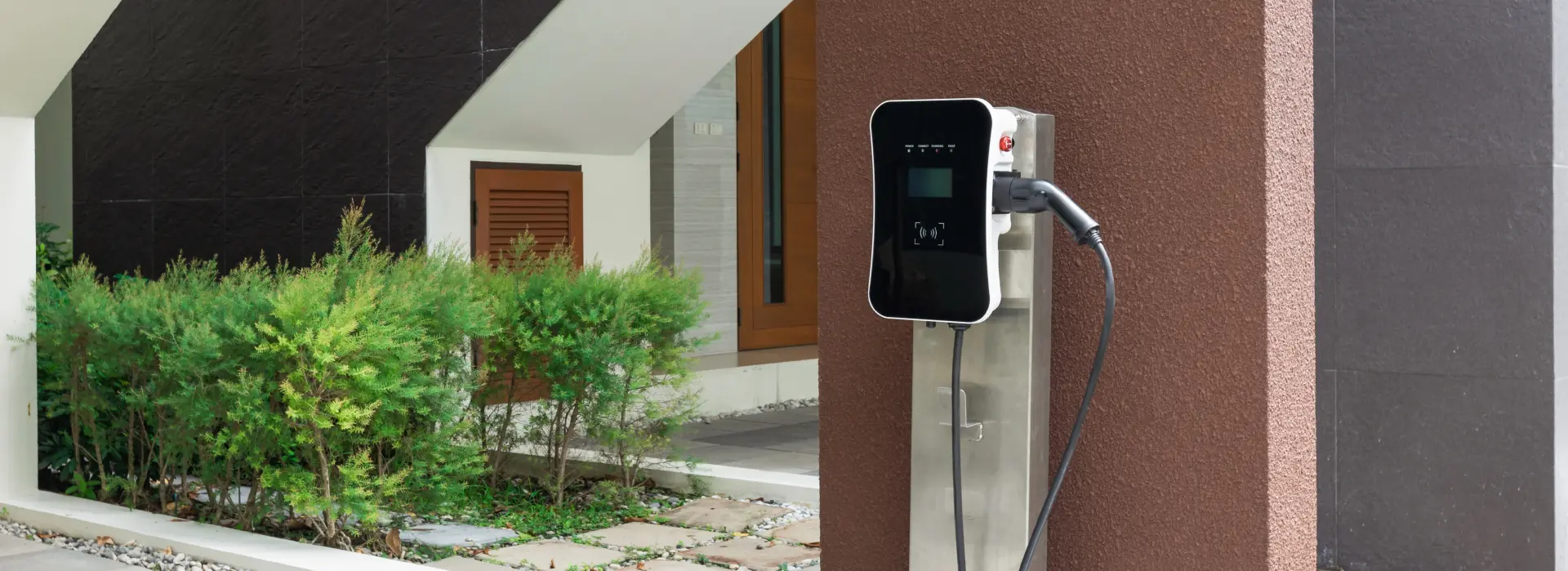
Illustrative image from the existing site library; eV charging connectors at a charging station.
Consider upstands and heritage restrictions
Freestanding upstands follow different conditions from wall-mounted outlets. The new residential height limit is 1.6 metres, with limits on provision per parking space. Include associated equipment when describing the whole installation to the authority.
Listed-building curtilage, scheduled monuments and conservation-area restrictions can prevent the straightforward permitted development route. An Article 4 direction may also affect rights. Seek specific advice before drilling into historic fabric or running visible cables. Listed building consent and planning permission are separate issues; landlord approval does not replace either where required.
Cross-pavement charging needs authorisation
The October 2026 changes create a route for qualifying cross-pavement solutions. A channel must be installed by, on behalf of, or with authorisation from the highway authority. Site restrictions still apply. Homeowners cannot simply cut a channel into a public pavement.
North Northamptonshire Council says qualifying residents can save more than £300 in planning fees under the reform. That is not a universal installation saving or a promise of approval in another borough. Local scheme availability matters, and a channel does not reserve the public parking space outside the house.
Keep property rights and electrical approval separate
Leaseholders should obtain required freeholder or management-company agreement for parking, communal land and cable routes. Tenants need the owner’s consent. Establish who controls the wall and space before committing to equipment.
The electrician must separately assess supply capacity, protection and network notification or approval requirements. Building Regulations compliance is not planning permission. If uncertainty remains, ask about a lawful development certificate based on the proposed position and dimensions. Property-specific written advice is more useful than discovering restrictions after the charger is fitted.
Sources and further reading
Guidance checked on 22 October 2026. Data periods are stated in the text; illustrative calculations are not survey findings.
- Planning Portal: rules effective 21 October 2026
- North Northamptonshire Council: cross-pavement rules and fees
- DfT: 21 October 2026 planning announcement and sales figures
- 2026 Amendment Order: electrical outlets
- 2026 Amendment Order: electrical upstands
- 2026 Amendment Order: cross-pavement solutions
Summary
Confirm the planning route, restrictions and any highway or property consents before installation. For the electrical survey and charger work, explore the installation service below.